Drainage for driveways and patios
Rain that lands on a driveway or patio has to go somewhere. Irish law says it must not run onto the public road, and the building guidance keeps it out of the foul sewer.
Checked against the sources on
In short
- The Roads Act 1993 says an owner or occupier must take reasonable steps to stop water running from their land onto a public road.
- Surface water must not be connected to a foul sewer, and foul water must not go to a surface water sewer.
- Technical Guidance Document H says a soakaway should not be built within 5 m of a building or road.
- A large front garden surface has to be permeable to stay exempt from planning permission.
Keeping water off the road
Section 76 of the Roads Act 1993 puts a duty on anyone whose land is beside a public road:
"The owner or occupier of any land adjacent to a public road shall take all reasonable steps to ensure that-" ... "water, soil or other material is prevented from flowing or falling onto a public road from his land."
The road authority can act on this. Under section 76(6), "A road authority may serve a notice in writing on the owner or occupier of any land adjacent to a public road", requiring them to carry out specified works or take specified measures.
Foul sewer and surface water
Technical Guidance Document H, the Irish guidance on drainage under the Building Regulations, quotes the regulation:
"(3) No part of a drainage system conveying foul wastewater shall be connected to a sewer reserved for surface water and no part of a drainage system conveying surface water shall be connected to a sewer reserved for foul wastewater."
Uisce Éireann's code of practice, written for developers, says: "Uisce Éireann does not have responsibility for Storm Water Sewers. These Storm Water Sewers are the responsibility of the Local Authority." It also says it is its policy not to accept surface water or storm water into its network.
Soakaways
A soakaway is a pit that lets water soak into the ground. Technical Guidance Document H says:
- "Soakaways should not be built: - (a) within 5 m of a building or road or in areas of unstable land;"
- "(b) in ground where the water table reaches the bottom of the soakaway at any time of the year;"
- and not within 5 m of a drainage field or another soakaway.
For small areas it describes the usual form: "Soakways for areas less than 100 m2 are generally formed from square or circular pits, filled with rubble or lined with dry-jointed masonry or perforated ring units." For larger areas it refers to BRE Digest 365, a British design method.
South Dublin County Council's pre-planning guidelines are written for planning applications in that county. They say soakaways must comply with BRE Digest 365 and that designs must include infiltration test results. They put a soakaway "at least 5m from any buildings, public sewers, road boundary or structures" and "generally, not within 3m of the boundary of the adjoining site", and say: "Only clean, uncontaminated surface water shall be discharged to soakaways." The Irish documents point to BRE Digest 365 for the soakage test.
Permeable surfaces
The Government's 2024 strategy on urban rainwater names paving as part of the problem: "The cumulative impact of works such as building extensions, garden paving, and conversion of lawns to hard standing for car parking or any such works that convert a permeable surface to an impermeable surface can all have significant impact."
Dublin City Council's booklet on parking in front gardens asks for "permeable or porous surfaces such as gravel and green areas" and says: "Large unrelieved areas of paving or other impermeable surface treatments will not be considered acceptable." The planning exemption for a front or side garden surface also depends on it. See when a driveway has to be permeable.
Tobermore, which makes permeable block paving in Northern Ireland, sets limits on it:
- It should take only the rain that lands on it, not water from roofs or other hard surfaces next to it.
- "The ground must be proven to accept 20mm of water in one hour" where the water is to soak away.
- "It is very important therefore that slopes have a maximum gradient of 1 in 20 (5%)."
Falls
Roadstone's laying guide says: "Falls should be built into the sub-base and the area should be free draining. A saturated sub-base and laying course is one of the main causes of failure and rutting." PavingExpert, a British site, says a fall of about 1 in 60 is usually adequate on private patios and drives. The fall and drainage calculator turns a ratio into a drop in millimetres.
Channel drains
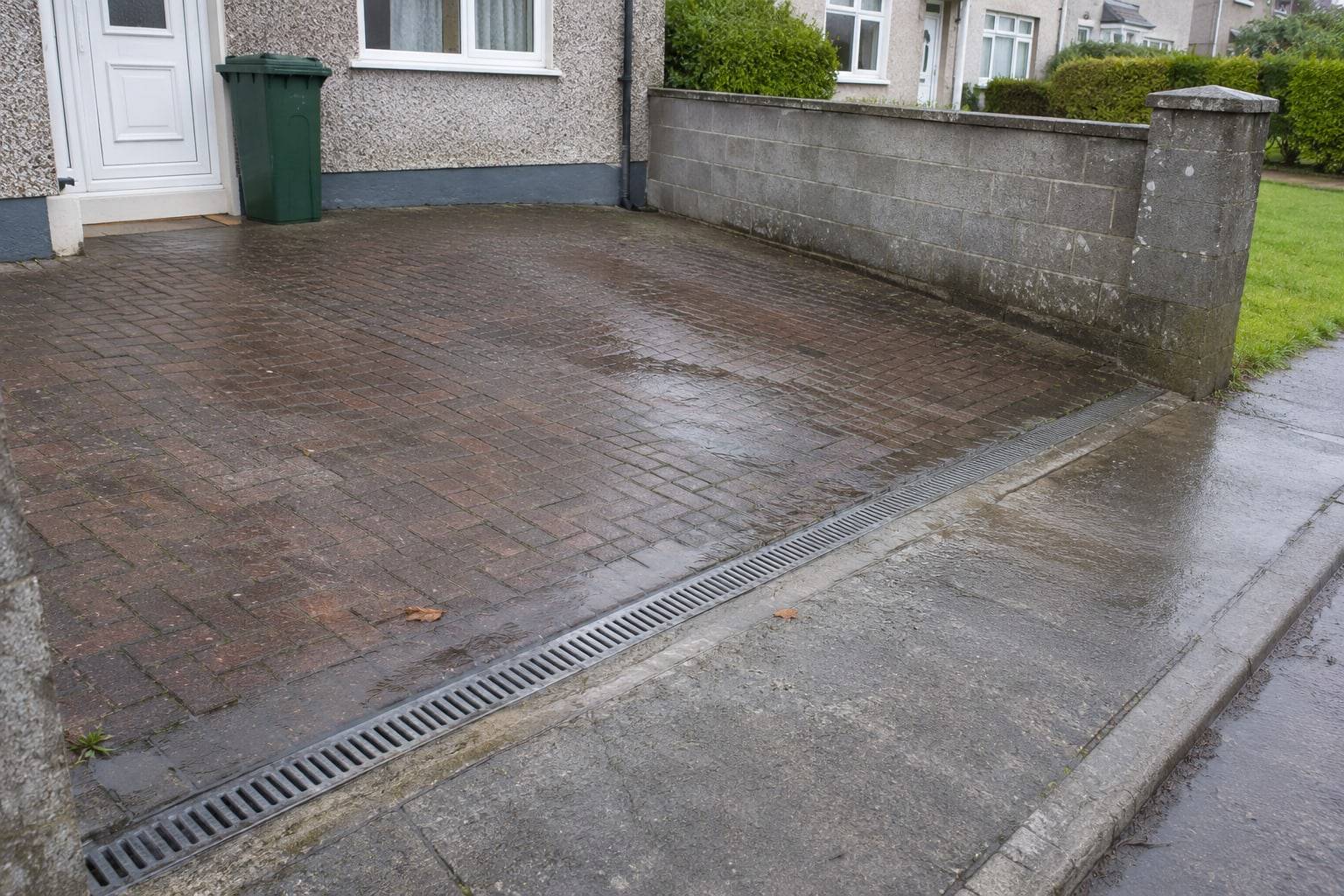
Channel drains, also called linear drains, are sold in load classes. ACO, a drainage manufacturer, says on its British site that most domestic projects need only the first three classes, with A 15 the most popular. For driveways it says: "in the case of driveways we would recommend at least a B 125." Water from a channel drain is surface water, so the rule on foul sewers above applies to it.
Sources
- Roads Act 1993, section 76 (Law Reform Commission revised Act)
- Department of Housing: Technical Guidance Document H, Drainage and Waste Water Disposal (2016)
- Uisce Éireann: Code of Practice for Wastewater Infrastructure, Revision 3, 2025
- South Dublin County Council: Surface Water Drainage Pre-Planning Guidelines, February 2022 update
- Department of Housing, Local Government and Heritage: Nature Based Management of Urban Rainwater and Urban Surface Water Discharges, A National Strategy, May 2024
- Dublin City Council: Parking Cars in Front Gardens Advisory Booklet (2018)
- Roadstone: Paving Laying & Maintenance Guide
- Tobermore: Guidelines for installing Hydropave permeable paving for domestic applications
- Tobermore: Hydropave permeable paving technical information
- PavingExpert: Laying flags (British)
- ACO: Drainage load classes (British)
This page is general information taken from published guidance. Products differ, so follow the laying and care instructions for the one you buy.
Related guides
- How a patio is builtThe layers from the ground up: digging out, sub-base, falls, bedding and jointing.
- Sub-base: Clause 804 and T1 StrucWhat the two materials are, which one goes under a building and which under paving.
- Which driveway surfaceSix driveway surfaces compared on rainwater, repairs, upkeep and cars.
- Gravel drivewaysStone size and depth, what goes underneath and how to keep the gravel in place.