Sub-base: Clause 804 and T1 Struc
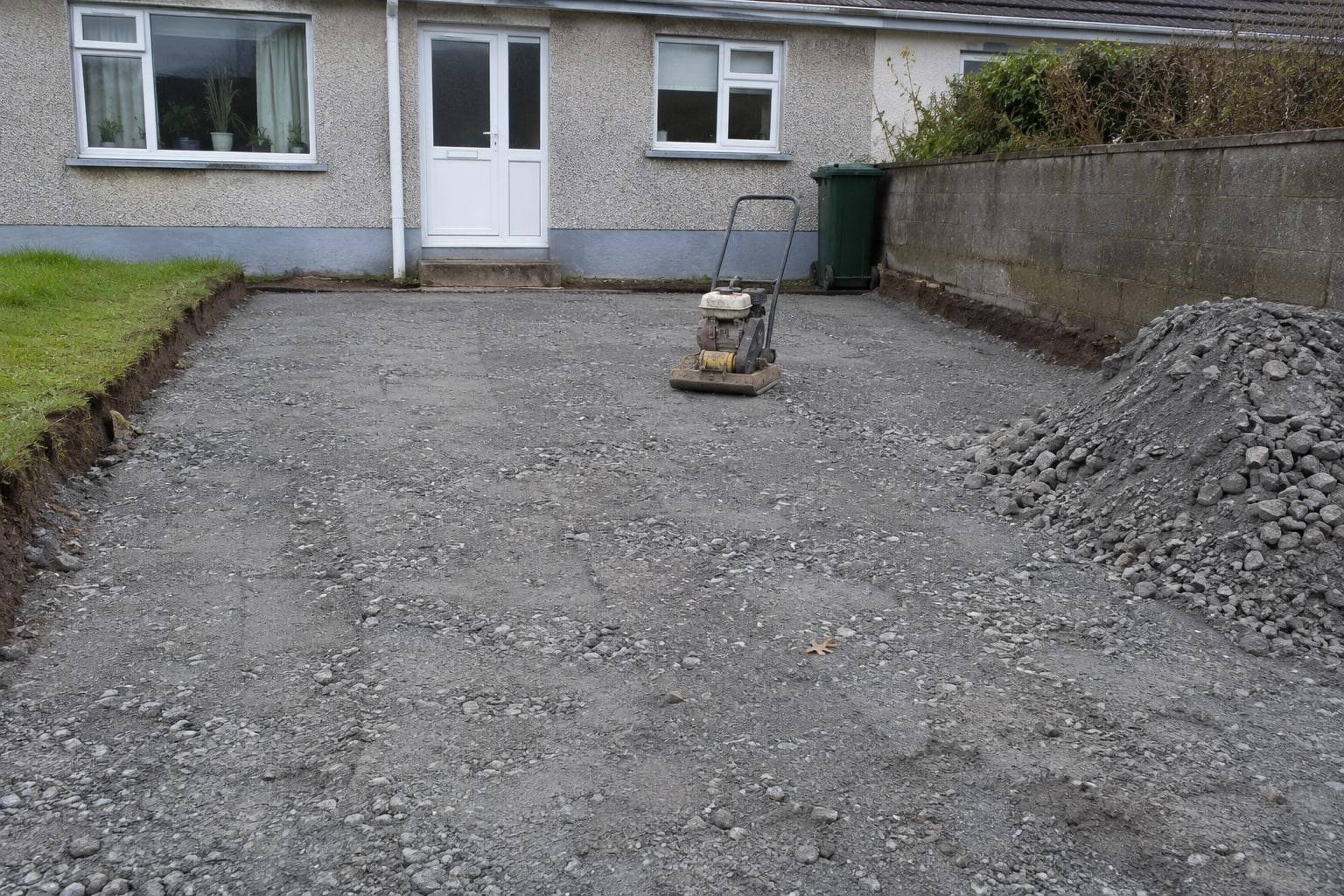
Clause 804 is the crushed stone widely used under Irish driveways and patios. T1 Struc is a grade of fill made to Annex E of S.R. 21, the part of the Irish standard that covers stone under concrete floors and footpaths.
Checked against the sources on
In short
- Clause 804 is a trade name. Roadstone now sells it as UGM, graded 0 to 31.5 mm, made to the TII road specification.
- Roadstone's laying guide gives 150 to 300 mm of compacted Clause 804 for most paving, depending on the ground and the load.
- Annex E of S.R. 21 covers stone for use under and next to concrete floors and footpaths. T1 Struc is one of its grades.
- For stone under a concrete floor or footpath, Roadstone says to specify Annex E material.
What Clause 804 is
PavingExpert, a British site that also covers Ireland, says the name comes from clause 804 of the Irish road specification, where the full specification was set out.
Roadstone, an Irish quarry company, now sells the stone as UGM (unbound granular material) and says it was previously known as Cl 804 stone. It says the stone meets the TII Specification for Roadworks and the Irish standards for unbound granular fill, and gives the grading as 0 to 31.5 mm. Its product page lists driveways, patios, road construction and paving foundations among the uses.
The British near-equivalent is MOT Type 1. PavingExpert treats the two as the same material under different names.
How deep the sub-base is
The depths published for house paving vary with the ground and the traffic.
| Source | Use | Compacted depth |
|---|---|---|
| Roadstone (Irish) | Most paving | 150 to 300 mm |
| PavingExpert (British) | House drives, paths and patios | 100 mm |
| PavingExpert (British) | Cars and small vans | 150 mm |
| Marshalls (British) | Natural stone patios | At least 100 mm |
| Marshalls (British) | Most house driveways | 150 mm |
Roadstone says the depth depends on the type of soil, how much build-up is needed and the load the finished surface will carry. To turn a depth and an area into tonnes, use the sub-base calculator.
Layers and compaction
The guides give different maximum layer thicknesses, written for different jobs:
- Marshalls' natural stone guide: "Sub-base material should be placed in layers not exceeding 75mm in thickness or twice the nominal maximum aggregate size."
- PavingExpert: "The sub-base material should be spread out in layers no thicker than 150mm".
- TII's road specification, which is written for roads compacted with rollers, allows UGM layers up to 225 mm compacted, with a minimum of 110 mm.
Marshalls also says recycled crushed masonry or concrete can be considered if it is well graded and compacts to a close finish, and that "Materials containing organic matter should not be used."
A membrane under the stone
PavingExpert says: "For the vast majority of light-use paving in Britain and Ireland, a membrane is not required." It adds that a membrane can help where the sub-grade is suspect, and that it goes on top of the dug-out ground. Kilsaran, an Irish manufacturer, tells installers to choose a geo-membrane if required. The glossary explains sub-grade, geotextile and the other terms on this page.
Annex E and T1 Struc
S.R. 21 is the Irish standard for unbound granular fill, published by NSAI. Roadstone explains that Annex E deals with stone for use under and next to concrete floors and footpaths. It was added in 2007 because pyritic material had got into the supply chain and caused "structural damage to a significant number of houses and buildings in the Greater Dublin region."
NSAI says the 2014 edition is a complete revision of the 2004 edition and its 2007 amendment, and that "Annex E has been revised in line with the recommendations of the Report of the Pyrite Panel 2012." It describes the material as unbound granular fill, commonly known as hardcore, for use under concrete floors and footpaths.
Roadstone's FAQ on Annex E names several grades:
- T1 Struc: 0/31.5 mm crushed rock or 0/40 mm gravel, for "where the overall depth of fill to subsoil is less than 900mm."
- T0 Struc: a coarser grade for deeper fill or heavy loads.
- T2 Perm: a layer that lets gas through, for buildings with a radon sump.
- T3 Blind: fine material that blinds the top of the T2 layer.
The same FAQ says certification of Annex E material has moved from self-certification (System 4) to independent certification (System 2+). It points to I.S. 888, the code of practice for buying and using this fill, and says "It is the sole responsibility of the customer/site contractor to establish a system of traceability".
Which goes where
Roadstone's FAQ says: "Annex E materials are the only materials that should be specified for use under concrete floors and footpaths". Its Clause 804 product page names driveways, patios and roads, and says nothing about use under buildings.
An older Roadstone paving guide, written to the 2007 edition of S.R. 21, mentions Annex E material for footpaths around houses and also "suitable Clause 804 material". The standard has been revised since, so for a path or slab against a house ask the supplier which material they would specify.
UGM A and UGM B
Transport Infrastructure Ireland (TII) now publishes the road specification as CC-SPW-00800, and it uses the names UGM A and UGM B (unbound granular mixture) instead of Clause 804. Roadstone's news item on the change lists both as the material previously called Cl804. TII says UGM A is expected to give better long-term performance than UGM B.
The two grades differ in how much recycled stone they may contain. Roadstone reports that the change allows "UGM A materials up to 30% content and UGM B materials up to 100% content" of reclaimed aggregate, and TII's 2023 slides show no limit for UGM B.
Sources
- Roadstone: Clause 804 (UGM) product page
- Roadstone: Changes to TII Series 800 specification allow inclusion of recycled aggregates
- TII: CC-SPW-00800 Road Pavements, Unbound and Hydraulically Bound Mixtures, Rev 05
- TII Standards Roadshow 2023: Updates to CC-SPW-00800 Unbound and Hydraulically Bound Materials
- Roadstone: Revision of SR21
- NSAI: Publication of S.R. 21 revised
- Roadstone: Annex E of SR 21 FAQs
- Roadstone: Paving Laying & Maintenance Guide
- Kilsaran: Block Paving Installation Guide
- PavingExpert: Sub-base (British)
- PavingExpert: Do I need a membrane? (British)
- Marshalls: Natural Stone Paving Installation Guide, Issue 5, January 2020 (British)
- Marshalls: Drivesys Driveway Concrete System Installation Guide (British)
This page is general information taken from published guidance. Products differ, so follow the laying and care instructions for the one you buy.
Related guides
- How a patio is builtThe layers from the ground up: digging out, sub-base, falls, bedding and jointing.
- Drainage for driveways and patiosFalls, channel drains and soakaways, and where the rainwater is allowed to go.
- Cobblelock and block pavingBlock sizes and thicknesses, the layers underneath, laying patterns and the usual problems.
- Gravel drivewaysStone size and depth, what goes underneath and how to keep the gravel in place.