Porcelain paving
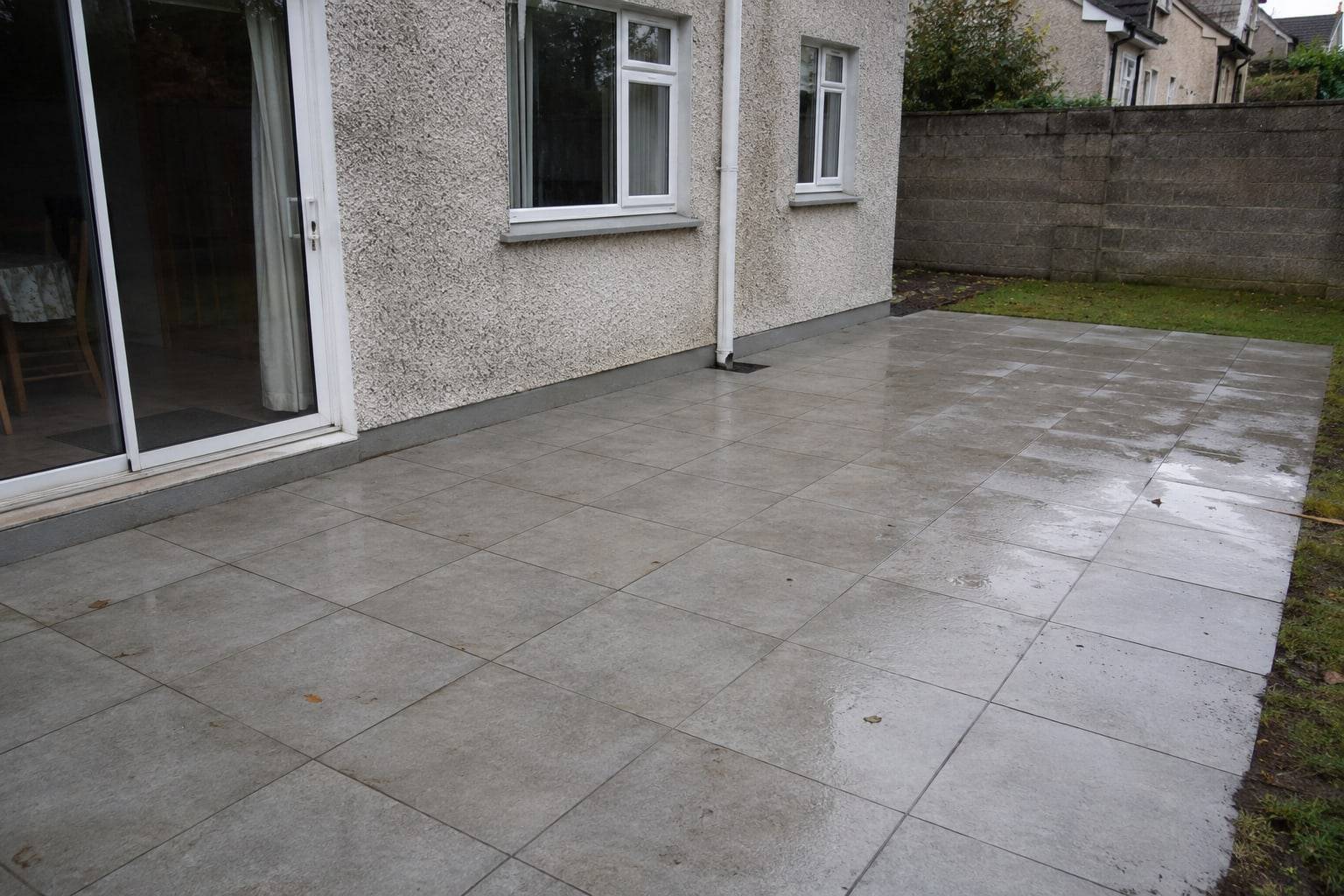
Outdoor porcelain is a dense fired slab, usually about 20 mm thick. It hardly takes in water, so it has to be primed on the back and laid on a full bed of mortar.
Checked against the sources on
In short
- Outdoor porcelain is mostly sold as 20 mm slabs. Roadstone lists 600 x 600 x 20 mm.
- Each slab needs a primer on the back before it goes down, or it will not bond to the mortar.
- Lay it on a full mortar bed. Spot bedding leaves gaps underneath.
- Check the product is meant for cars before using it on a driveway. Roadstone's porcelain is listed for pedestrian use.
What outdoor porcelain is
Paving Expert, a British technical site, says porcelain is made from special clays fired at very high temperatures. It defines porcelain as "products with a water absorbency of 0.5% or less", which is why the slabs take in so little water.
Paving Expert puts the better products at 17 to 22 mm thick. Roadstone, an Irish supplier, lists its porcelain flags at 600 x 600 x 20 mm and describes them as scratch and stain resistant. To work out how many you need, use the paving slab calculator.
Why it needs a primer
Because the back of a porcelain slab takes in almost no water, ordinary mortar does not grip it. Paving Expert says "without help, these tiles will not form a strong, sustainable bond to either bed or jointing." It says a bond bridge primer on the underside of the tiles is needed.
Marshalls, a British manufacturer, gives the same instruction for its own product: "Porcelain paving must be primed with a Marshalls Paving Primer before installing onto a full mortar bed." A British tile retailer says to prime the underside of every slab with a priming slurry just before laying it.
The bed underneath
The slab needs mortar under its whole area. The same tile retailer says: "Avoid spot bedding. Porcelain requires 100% full coverage to prevent voids or cracking." Another British retailer says a stable base, a full mortar bed and a slurry primer are normally needed for an outdoor job.
Porcelain slabs are made to accurate sizes, which shows up faults in the work below. That retailer warns: "Uneven bedding, incorrect falls, poor bonding or misaligned joints are more noticeable on accurately calibrated slabs." The sand and cement calculator works out the mortar for a slab bed, and how a patio is built covers the layers under it.
Porcelain can also sit on adjustable pedestals instead of mortar. The tile retailer says to put them at the corners of each tile, and at the mid-points if needed, on a stable surface such as concrete or screed.
Joints, cutting and chipped edges
One British retailer recommends a 5 mm gap and a good quality external tile grout. Paving Expert recommends a two-part resin slurry for the joints instead, because of the bond, and warns that any cement haze left on the face has to be cleaned off thoroughly.
For cutting, Paving Expert says "there is only ONE suitable cutting method: a powered cut-off saw fitted with a good quality diamond blade". The tile retailer specifies a continuous-rim porcelain diamond blade.
A British retailer says the face of the slab is highly wear-resistant, but exposed edges and corners can chip if something hard or heavy hits them.
Staining and slip resistance
Marshalls says porcelain paving is impermeable and resists staining from oil, moss and algae. Royale Stones, an Irish retailer, says its dense surface means staining and fading are not much of a worry, and that it needs no sealing.
Roadstone gives its porcelain an "R11 slip-resistant rating". Marshalls says its own porcelain meets British Standards for slip resistance. British product sheets often give two slip figures. The R rating comes from a ramp test, and the pendulum test value is a separate measure. Both are measured on new slabs in a laboratory, and how the surface is kept affects grip afterwards.
Porcelain on a driveway
Roadstone's page lists only one use for its porcelain flags: pedestrian. Royale Stones says "a driveway needs something rated for vehicle weight", and that the bedding and jointing have to be right.
Marshalls sells a porcelain product made for driveways, and it is built differently from a patio slab: "Each slab combines a 10mm porcelain surface with a 50mm concrete backing". Marshalls says it is designed to be laid on a flexible bed.
Sources
- Paving Expert: porcelain and ceramic paving (British)
- Roadstone: porcelain paving product page
- Marshalls: porcelain driveway (British)
- Marshalls: garden paving technical information (British)
- Royale Stones: driveway paving buying guide (Irish retailer)
- Tile.co.uk: the complete guide to installing 20mm outdoor porcelain tiles (British retailer)
- London Stone: how to lay porcelain slabs (British retailer)
- Paving Slabs UK: what are the disadvantages of porcelain paving (British retailer)
This page is general information taken from published guidance. Products differ, so follow the laying and care instructions for the one you buy.
Related guides
- Porcelain or sandstoneHow the two patio slabs differ on staining, slip, laying and ageing.
- Indian sandstoneColours and finishes, calibrated slabs, staining and algae, and how the stone is sourced.
- How a patio is builtThe layers from the ground up: digging out, sub-base, falls, bedding and jointing.
- Cleaning and sealing pavingAlgae, black spot, white bloom and rust marks, and when a sealer is worth using.