Cleaning and sealing paving
Paving manufacturers agree on regular brushing and gentle washing. They disagree about acid cleaners and about whether to seal at all.
Checked against the sources on
In short
- Brush regularly. If you use a power washer, keep it on medium pressure or lower and aim it at an angle.
- Put back any joint sand that washes out, once the paving is dry.
- Keep lawn feed or moss killer containing sulphate of iron off paving. Several makers say it stains.
- White bloom fades with time. Makers differ on using acid to remove it.
- Marshalls does not recommend sealing its paving outdoors. Kilsaran recommends it.
Routine cleaning
Roadstone, an Irish manufacturer, says general dirt should be removed by regular dry brushing. For stubborn areas it allows a power washer on a medium setting or lower, aimed at the paving at an angle of about 30 degrees rather than straight down, taking care not to wash out the sand or mortar in the joints.
Other makers give similar advice:
- Tobermore recommends cleaning 2 to 3 times a year and says a light hose at medium pressure is usually enough. It warns: "Do not use high pressure powerwashers as aggressive power-washing can damage the product surface."
- Marshalls says to keep the power washer on a low pressure setting and not to use an oscillating lance.
- Kilsaran says that if paving is cleaned regularly, power washing and chemicals should not be needed.
- Brett, on block paving, says equipment that vacuums or water blasts the paving can remove large amounts of joint sand.
Roadstone also says block paving "should only be brushed by hand", because mechanical sweepers can pull the sand out of the joints and the blocks lose their interlock.
Joint sand
Roadstone says to replace washed-out jointing sand with dry sand once the paving has dried. Kilsaran says to top up joints with kiln dried jointing sand in dry conditions only, and warns that joints that are not full can let the paving move and let water wash out underneath. Tobermore says any jointing material that is removed must be replaced, and Brett says lost sand should be refilled during the 12 months after the paving is laid.
Algae, moss and lichen
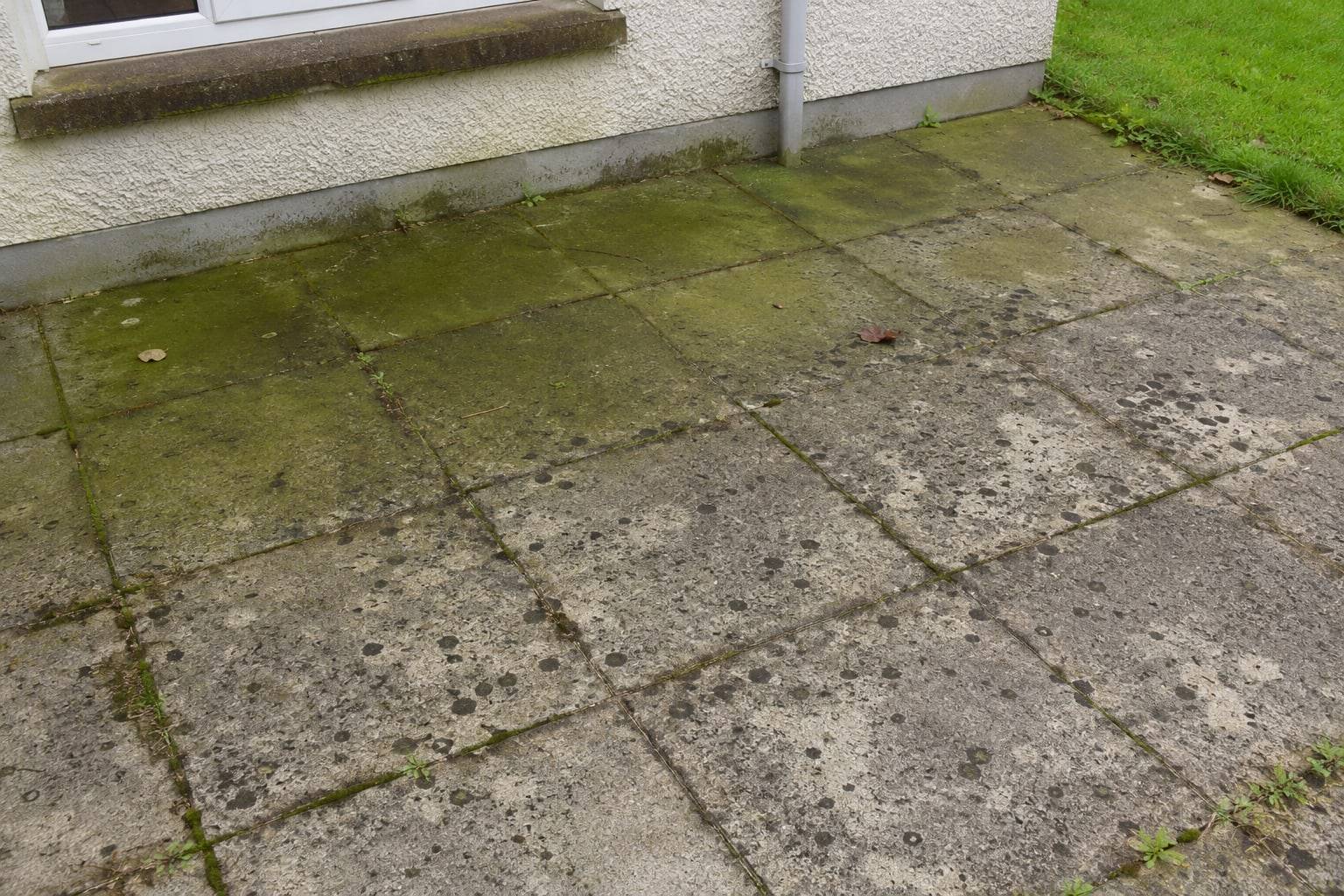
Marshalls says growth is worse where the driveway or patio is shaded and water ponds on it. Kilsaran says algae can be treated with a water-based fungicide. Lichen shows as white or black spots, and Kilsaran says it needs a fungicide or bleach and may take several treatments. Tobermore says its anti-moss product works best in dry weather.
Watch what goes on the garden nearby. Roadstone says: "The use of sulphate of iron is not recommended as it will stain the paving." Tobermore says lawn feed containing ferrous sulphate can stain concrete products, and Marshalls gives a similar warning.
White bloom (efflorescence)
Roadstone describes efflorescence, also known as lime bloom, as a white deposit that can cover part or all of the surface. Marshalls says it comes from a reaction between cement and water in all cement-based concrete products. Both say it goes in time, and Roadstone calls it temporary. Marshalls says "This usually takes up to 3 months to clear or improve, but sometimes can take 6-8 months." Brett says it normally disappears within 12 months.
On removing it, the makers disagree:
| Maker | On acid cleaners for white bloom |
|---|---|
| Kilsaran (Irish) | Advises against any acid cleaner. Best left to weather away. |
| Roadstone (Irish) | Can be removed with an acidic washing agent, applied to paving soaked first with clean water, following the product's instructions. |
| Brett (British) | Only once the bloom has finished forming. Not recommended on natural stone or decorative concrete flags. |
Rust, oil and acid
For oil, Roadstone says: "DO NOT wipe the oil - this drives it into the concrete and spreads the spill over a larger area." It suggests soaking it up and then using a degreaser, with neat washing-up liquid as a starting point until you have one. For rust, Marshalls' aftercare guide starts with lemon juice or vinegar, then a cleaner made with an acid other than hydrochloric.
Marshalls warns: "Many common patio cleaners & brick acids are hydrochloric acid based and are not appropriate on most of our products, incl. sandstone." Brett says acid can etch, bleach or prematurely age the paving surface. An older Marshalls guide for commercial natural stone floors goes further and rules out all household and commercial cleaning chemicals, including bleach, on natural stone. Its domestic guide allows mild household bleach on some stains, so check the instructions for the paving you have.
Where the water goes
Roadstone says run-off from cleaning should be channelled carefully to drainage points or into containers, and disposed of safely. Marshalls asks owners not to damage or contaminate turf or ponds nearby. We did not find Irish public guidance on cleaning products reaching drains.
Sealing
| Maker | On sealing |
|---|---|
| Marshalls (British) | "Marshalls does not recommend the use of any form of sealant on our products if installed externally." |
| Kilsaran (Irish) | Recommends sealing to make cleaning and maintenance easier. |
| Tobermore (Northern Irish) | Block paving can be sealed with a resin to resist staining and weeds. Not on its EasyClean products. |
| Brett (British) | Wait 12 to 18 months, so any white bloom has weathered first. |
| Roadstone (Irish) | Sealants may need reapplying, depending on how much the paving is used. |
Brett explains its wait: "Sealing before efflorescence has concluded may trap any salt build up under the sealer making the efflorescence extremely difficult to remove." It also says sealing can change how the paving looks and how slippery it is.
Ice and salt
Marshalls says: "Never use common salt to de-ice reconstituted stone or limestone." It says there are products made for this, though de-icer may leave some temporary discolouration. Brett says not to use de-icing salts on its block paving.
Sources
- Roadstone: Paving Laying & Maintenance Guide
- Kilsaran: Guidelines for the maintenance of Classic Modular block and flag paving, 2021 (copy hosted by Hardscape Products)
- Tobermore: Guidelines for installation of paving flags
- Marshalls: Patio and Driveway Aftercare Guide (British)
- Marshalls: Natural Stone Cleaning & Maintenance Guidelines, March 2011 (British, commercial)
- Brett Landscaping: Essential Maintenance Guide, as published by Camden Council (British)
This page is general information taken from published guidance. Products differ, so follow the laying and care instructions for the one you buy.
Related guides
- Indian sandstoneColours and finishes, calibrated slabs, staining and algae, and how the stone is sourced.
- Cobblelock and block pavingBlock sizes and thicknesses, the layers underneath, laying patterns and the usual problems.
- Porcelain pavingWhat outdoor porcelain is, how it has to be laid and where it goes wrong.
- How a patio is builtThe layers from the ground up: digging out, sub-base, falls, bedding and jointing.