Indian sandstone
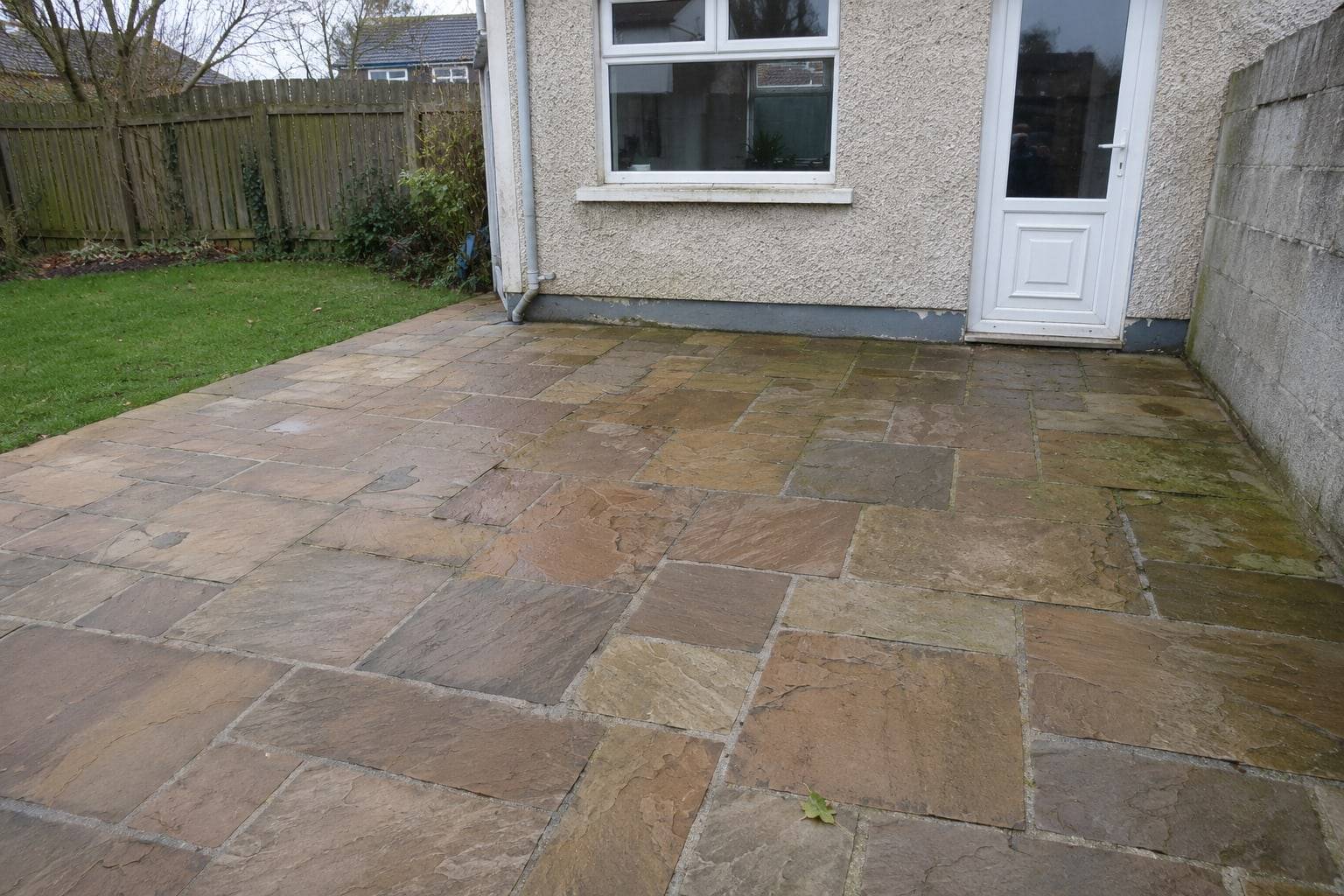
Indian sandstone is a natural stone sold in Ireland as 20 mm slabs with a riven face. The colour varies from slab to slab, and the stone takes in water, so moss and marks need more attention than on porcelain.
Checked against the sources on
In short
- Mix slabs from several packs as you lay them so the colours are spread out.
- Calibrated slabs are cut to one thickness. Uncalibrated stone needs the bed adjusted under each slab.
- Prime the back of each slab before it goes on the mortar bed.
- Be wary of acid cleaners. Paving Expert warns they can turn pale sandstone rust coloured.
- Ask the supplier where the stone was quarried and how it checks working conditions.
What is sold in Ireland
Roadstone, an Irish supplier, sells Indian sandstone in four sizes, 300 x 300, 600 x 300, 600 x 600 and 900 x 600 mm, all 20 mm thick. Its colours are Gardha buff, Khandla Grey and Mint, and it describes the face as riven. The paving slab calculator works out how many slabs or packs you need.
Roadstone calls the stone a hand finished product with a range of colours and hues, and says: "It is advisable as always for the contractor to blend from as many packs as possible to maintain the natural look."
Colour, fossils and iron marks
CED Stone, a British supplier, says colour varies across all natural stone, and that you may find fossil markings on some flags.
It also explains the orange or brown spots that sometimes appear. Some natural stone contains small amounts of iron, and with moisture these can show as marks. CED Stone's view is that "Oxidation in any natural stone is completely normal, specific cleaning products may help make any marks less noticeable."
Calibrated and uncalibrated slabs
Natural stone slabs are not all the same thickness. Marshalls, a British manufacturer, sells calibrated sandstone, cut to a consistent thickness so it is quicker and more precise to lay. Where the thickness varies, the bed has to make up the difference. One British retailer says that with sandstone "the mortar bed needs to be adjusted slab by slab".
Marshalls advises priming natural stone as well as porcelain: "For best practice, please slurry prime all natural stone and porcelain paving using Marshalls Paving Primer." See porcelain paving for why primer matters on dense slabs.
Water, moss and sealing
Sandstone takes in water. A British retailer that sells both materials says it is porous, and that algae and moss may grow in shaded or damp spots.
Royale Stones, an Irish retailer, says sealing sandstone every so often keeps moss and staining in check. Paving Expert, a British technical site, says "A properly applied quality sealant can keep a pavement in near pristine condition". Marshalls says its sawn sandstone should be sealed if used indoors; its outdoor guidance is about priming the back.
Acid cleaners
Paving Expert warns that "Many of the paler Indian sandstones exhibit a violent rusty reaction to acid", and puts this down to the iron in the stone. London Stone, a British retailer, is less strict: it says some situations "may warrant the use of acid natural stone paving cleaners on non-calcareous stones like granite, slate, or sandstone." The two sources disagree on sandstone. More on stains and moss is in cleaning and sealing paving.
How the stone is sourced
Child labour has been reported in Indian stone quarries. The Ethical Trading Initiative (ETI), a British ethical trade body, cites a UNICEF figure: "UNICEF estimates that nearly 20% of the workers in a typical Indian quarry are children."
The ETI publishes sector guidance for natural stone from Rajasthan, built on its Base Code. Clause 4 of that code is short: "Base Code clause 4: Child labour shall not be used".
You can ask the supplier which country and region the stone came from, and whether its suppliers follow the ETI Base Code or a similar code.
Sources
- Roadstone: Indian sandstone product page
- Marshalls: garden paving technical information (British)
- CED Stone: variations in natural stone (British)
- Universal Paving: Indian sandstone vs porcelain paving (British retailer)
- Royale Stones: driveway paving buying guide (Irish retailer)
- Paving Expert: taking care of paving (British)
- London Stone: beware of using acid to clean natural stone paving (British retailer)
- Ethical Trading Initiative: Marshalls tackling child labour in India (British)
- Ethical Trading Initiative: natural stone sector guidance, Rajasthan, India (British)
This page is general information taken from published guidance. Products differ, so follow the laying and care instructions for the one you buy.
Related guides
- Porcelain or sandstoneHow the two patio slabs differ on staining, slip, laying and ageing.
- Porcelain pavingWhat outdoor porcelain is, how it has to be laid and where it goes wrong.
- Limestone and graniteIrish and imported limestone and granite as slabs and setts, and how each wears.
- Cleaning and sealing pavingAlgae, black spot, white bloom and rust marks, and when a sealer is worth using.