Cobblelock and block paving
Cobblelock is concrete blocks laid on a bed of sand over a compacted stone sub-base, held in at the edges by kerbs, with fine sand brushed into the joints.
Checked against the sources on
In short
- Roadstone's guide gives a sub-base of 150 to 300 mm of compacted Clause 804, depending on the ground and the load.
- The sand bed under the blocks is 40 mm thick after compacting in Roadstone's guide.
- Kerbs hold the blocks in. They are set on and backed with concrete.
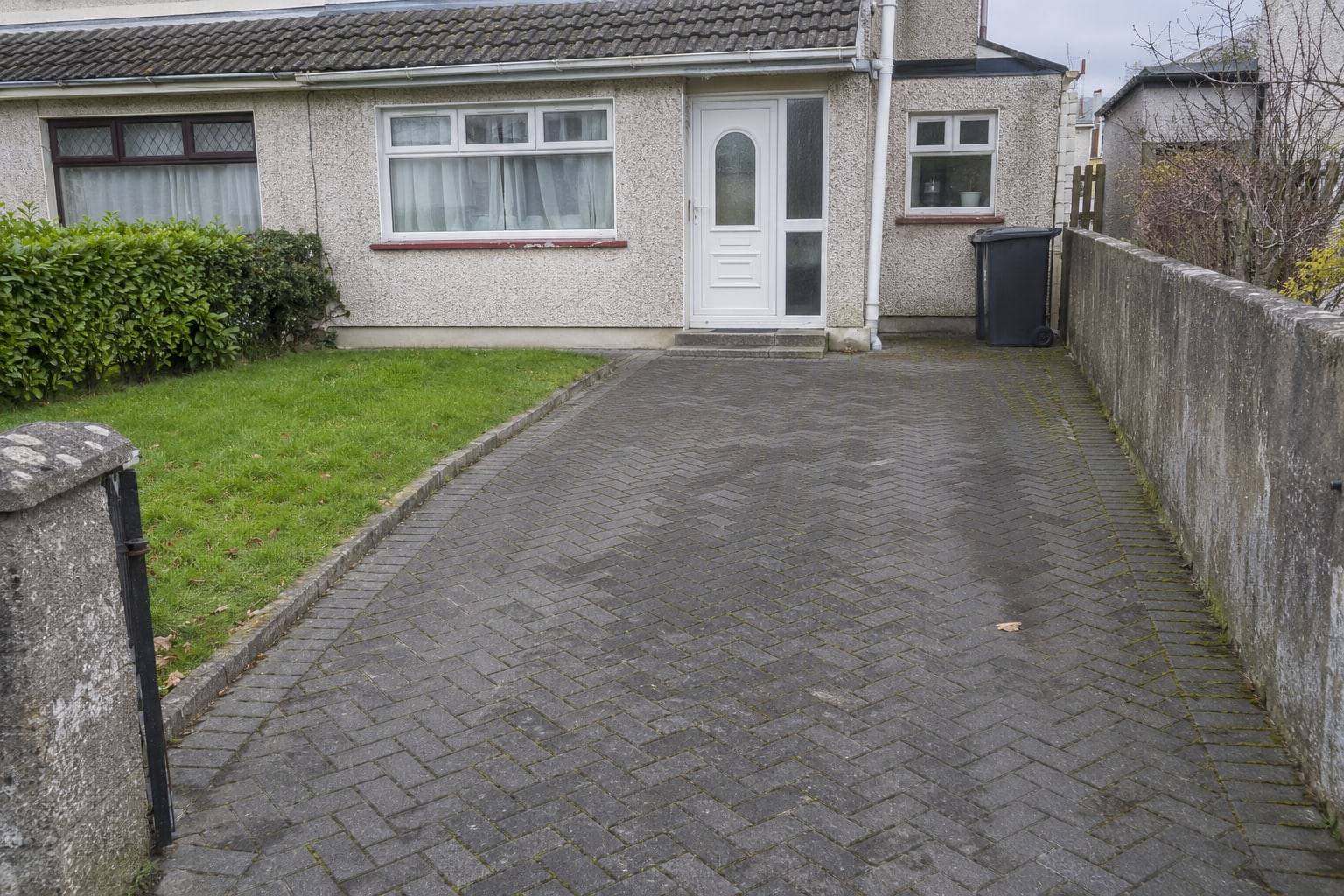
- On a driveway use herringbone or stretcher bond. Manufacturers say basket weave is not for areas cars drive on.
- Top up the joint sand after 28 days, and keep mechanical sweepers off it.
The blocks and how thick they are
Cobblelock is the usual Irish name for concrete block paving. Kilsaran, an Irish manufacturer, lists its blocks at 50, 60 and 80 mm thick and says different depths suit different traffic loads. Its data sheet says the blocks take pedestrians and cars when laid on the right sub-base, and are not for trucks or commercial vehicles. A 200 x 100 mm block works out at 50 blocks to the square metre.
Marshalls, a British manufacturer, sells its standard Tegula block at 50 mm for driveways, paths and patios, with 60 and 80 mm versions for access roads and car parks. Tobermore's permeable blocks come in 60 or 80 mm. Ask the supplier which thickness suits a driveway for the product you are buying. To count blocks and packs, use the block paving calculator.
Roadstone, another Irish manufacturer, says its blocks are made to I.S. EN 1338:2003, the Irish edition of the European standard for concrete paving blocks. For laying, it points readers to BS 7533 Parts 1 to 9, which is a British standard. Tobermore, based in Northern Ireland, also says its products should be laid to the latest British Standard.
The sub-base
Roadstone's guide gives the depth of stone under the blocks:
"Typically a sub-base of compacted Clause 804 or similar, between 150mm and 300mm deep will be sufficient for most applications, depending on soil type, depth of build-up required and loading that will be applied to the finished surface."
Clause 804 is the Irish crushed stone sub-base (the British near-equivalent is MOT Type 1). Marshalls says 150 mm is enough for most domestic jobs, laid in layers of no more than 75 mm at a time. See sub-base: Clause 804 and T1 Struc, or work out tonnes with the sub-base calculator.
Roadstone says the falls should be built into the sub-base and the area should drain freely, and warns that "A saturated sub-base and laying course is one of the main causes of failure and rutting." Marshalls gives a minimum fall of 1 in 80 along a driveway and 1 in 40 across it. The fall calculator turns a fall into millimetres.
The sand bed and the edges
The blocks sit on a laying course of washed grit sand, 40 mm thick after final compaction in Roadstone's guide. Tobermore's laying guide for its Manhattan block gives 20 to 40 mm of compacted bedding sand. Roadstone also says the sand should not be laid on saturated ground. The sand and cement calculator works out the bedding sand.
The edges have to be held so the blocks cannot spread. Roadstone says concrete kerbs are generally used, fixed in place by haunching them with concrete. Kilsaran says edge restraints and kerbs should be laid solidly on a concrete bed to stop the paved area moving. Marshalls says the edge restraints go in before the sub-base.
Laying and jointing
Kilsaran warns: "do not use blocks cut smaller than a quarter of their original size as this significantly weakens the block." Once the blocks are down they are compacted with a plate vibrator, and kiln dried sand is brushed over and vibrated in until the joints are full. Kilsaran says to do the jointing on a dry surface. The sand settles, so Roadstone says:
"Top up with jointing sand again in 28 days and follow regular maintenance procedures afterwards. The finished area is now suitable for all traffic."
Laying patterns
Tobermore says stretcher bond, at 45 or 90 degrees, and herringbone are suitable for driveways, and that basket weave should not be used on them. Marshalls says the same: "Basket weave patterns should not be used in areas receiving vehicular traffic." Both statements are written for their permeable ranges. For paths and patios Tobermore says any pattern will do.
Permeable block paving
Some front gardens have to be paved with a surface that lets rain soak away. See the permeable paving rule. Permeable blocks have wider joints, and Interpave, the British trade body, says these are filled with angular stone rather than sand. Tobermore says: "Do not replace the jointing grit with kiln dried sand as this will block the joins and prevent infiltration."
Interpave and Tobermore both limit the slope of a permeable surface to about 1 in 20. Tobermore also says to test the ground first: "A square test hole measuring 400mm x 400mm x 400mm should be dug for every 20-25m2 of driveway." If the water does not drain away, it says not to use permeable paving. Roadstone says its permeable blocks should be brushed at least twice a year.
White marks, colour and stains
A white bloom on new blocks is efflorescence. Roadstone says it is not a manufacturing fault: "The phenomenon is temporary and will, with time, disappear as a result of normal traffic and weathering." It can be removed with an acidic cleaner. Roadstone also treats some variation in colour and texture as normal in concrete, and suggests looking at samples before ordering. Tobermore says new blocks will look different from ones that have weathered for a while.
Roadstone says oil soaks readily into most concrete paving, so wipe up spills quickly. Tobermore notes that light coloured blocks show tyre marks and oil more, and says block paving can be sealed with a resin to resist staining and weeds.
Cleaning and weeds
- Tobermore recommends cleaning two to three times a year, and says not to use high pressure power washers.
- Roadstone says mechanical sweepers and strong suction sweepers can pull the sand out of the joints, which "will cause the loss of interlock and failure of the paved surface."
- Roadstone says to pull weeds as they appear, and not to use sulphate of iron because it stains the paving.
See cleaning and sealing paving for more.
Sources
- Roadstone: Paving Laying & Maintenance Guide
- Kilsaran: Block Paving Installation Guide
- Kilsaran: Newgrange blocks technical data sheet
- Tobermore: Guidelines for installing Hydropave permeable paving for domestic applications
- Tobermore: Manhattan block paving laying guidelines
- Marshalls: Installation details for Drivesett Tegula Priora concrete paving, September 2021 (British)
- Marshalls: Drivesys Driveway Concrete System Installation Guide, January 2020 (British)
- Marshalls: Drivesett Tegula Original block paving product page (British)
- Interpave: Understanding Permeable Paving, Edition 5, April 2013 (British)
This page is general information taken from published guidance. Products differ, so follow the laying and care instructions for the one you buy.
Related guides
- Tarmac or block pavingHow the two driveway surfaces differ on repair, drainage and upkeep.
- Sub-base: Clause 804 and T1 StrucWhat the two materials are, which one goes under a building and which under paving.
- Drainage for driveways and patiosFalls, channel drains and soakaways, and where the rainwater is allowed to go.
- Cleaning and sealing pavingAlgae, black spot, white bloom and rust marks, and when a sealer is worth using.