Concrete and imprinted concrete
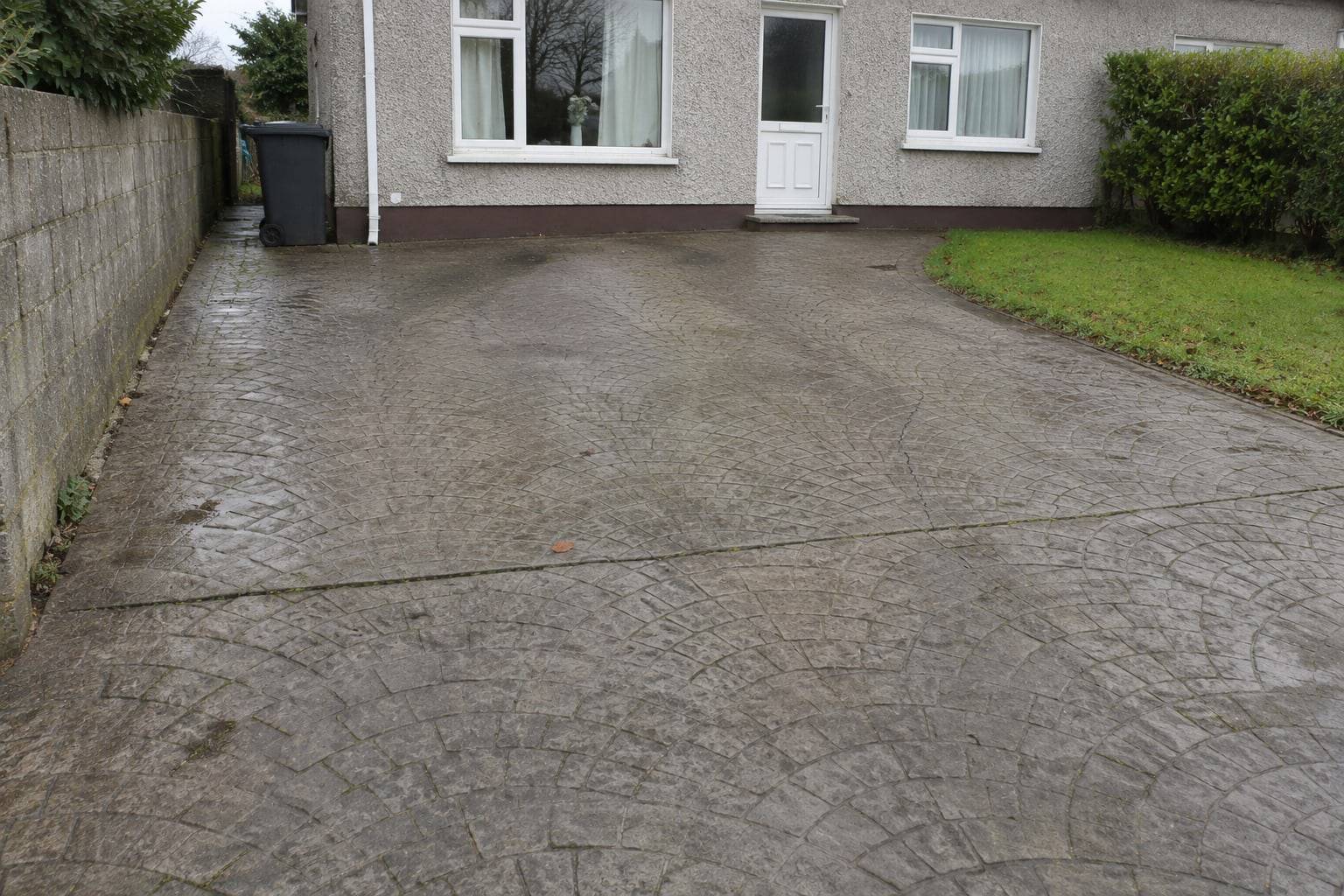
Pattern imprinted concrete is a concrete slab that is coloured and stamped with a pattern while it is wet, then sealed. Most of the published detail on it is British.
Checked against the sources on
In short
- A British reference site gives 100 mm as the minimum slab for a driveway and 75 mm for a path.
- The sealer has to be recoated every few years. The figures published run from two to five years.
- The finished surface does not let rain through, so plan where the water will go.
- Roadstone says not to use ammonia based de-icers on concrete.
- Protect freshly poured concrete if frost is forecast.
How imprinted concrete is made
Paving Expert, a British technical site, describes the process. Once the concrete is poured, a colour dye mixed with a surface hardener is scattered over it by hand. A release agent goes on next, also by hand, and the pattern is pressed in. Between 24 and 96 hours later the hardened surface is power washed to take off the excess release agent, and then it is sealed in one or two coats.
The same site gives a minimum thickness of 75 mm for paths and 100 mm for driveways and parking. It describes the mix as fairly strong, with 300 to 375 kg of cement in each cubic metre. It says steel mesh is not usually specified for a house driveway in imprinted concrete, and that polyester fibres are used in the mix instead. The concrete calculator works out the volume for a given area and thickness.
Paving Expert says most jobs need crack control joints. These are sawn to between a quarter and a third of the slab depth, normally a week or more after sealing, so that any cracking happens along the joints.
Sealing, cracks and repairs
Paving Expert puts the life of a good acrylic sealer at two to five years, after which it should be recoated. Marshalls, a British manufacturer that also makes block paving, says the sealer needs reapplying every two to four years. Marshalls also says:
- cracks appearing in imprinted driveways are not uncommon
- a patch repair is possible, but it can mean resurfacing whole areas
- the sealer can be very slippery, especially when it ices over in winter
Paving Expert says concrete, like tarmac, can only be cut out and patched, and the repair usually stays visible.
Frost and de-icing salt
Roadstone, an Irish supplier, says that for wet outdoor surfaces exposed to freezing and thawing, the concrete standard IS EN 206 recommends air entrained concrete or a higher strength grade. Ask the supplier which grade it would send for a driveway. Roadstone also says de-icing salts can damage the surface of concrete, that ammonia based de-icers are particularly aggressive and should not be used, and that fresh concrete has to be protected from freezing if frost is likely overnight.
Where the rain goes
Paving Expert and Marshalls both describe the finished surface as impermeable, so plan where the water will run to. In a front garden, a large area of hard surface has to be permeable or drain to ground to stay exempt from planning permission. See the permeable paving rule and drainage for driveways and patios.
Written specifications
The Concrete Society in Britain publishes a model specification for imprinted concrete, CS154, now in its third edition from 2018. Its listed contents cover site preparation, sub-base, drainage, edging, colouring and printing, joint cutting and sealing. It is a paid document.
Sources
- Concrete Society: Imprinted concrete, model installation clauses and guidance notes (CS154) (British)
- Paving Expert: pattern imprinted concrete (British)
- Marshalls: Concrete Driveways: Block Paving or Pattern Imprint? (British)
- Roadstone: Concrete in cold weather guidelines
- Paving Expert: repairing and replacing paving (British)
This page is general information taken from published guidance. Products differ, so follow the laying and care instructions for the one you buy.
Related guides
- Tarmac or block pavingHow the two driveway surfaces differ on repair, drainage and upkeep.
- Cobblelock and block pavingBlock sizes and thicknesses, the layers underneath, laying patterns and the usual problems.
- Drainage for driveways and patiosFalls, channel drains and soakaways, and where the rainwater is allowed to go.
- Which driveway surfaceSix driveway surfaces compared on rainwater, repairs, upkeep and cars.