Limestone and granite
Blue limestone from Kilkenny is sold in many finishes, and the quarry publishes slip, water and frost figures for it. For granite, most of the published advice is about setts on driveways.
Checked against the sources on
In short
- The finish decides how slippery limestone is when wet. A flamed face grips; a stonewashed face is smoother.
- Kilkenny Limestone says 3 cm slabs are generally enough for a patio. A driveway needs thicker stone.
- Never use acid cleaners on limestone.
- Kilkenny Limestone advises a hose and soft brush, and not a pressure washer.
- Granite setts on a driveway depend on a well compacted base.
Kilkenny limestone finishes and slip
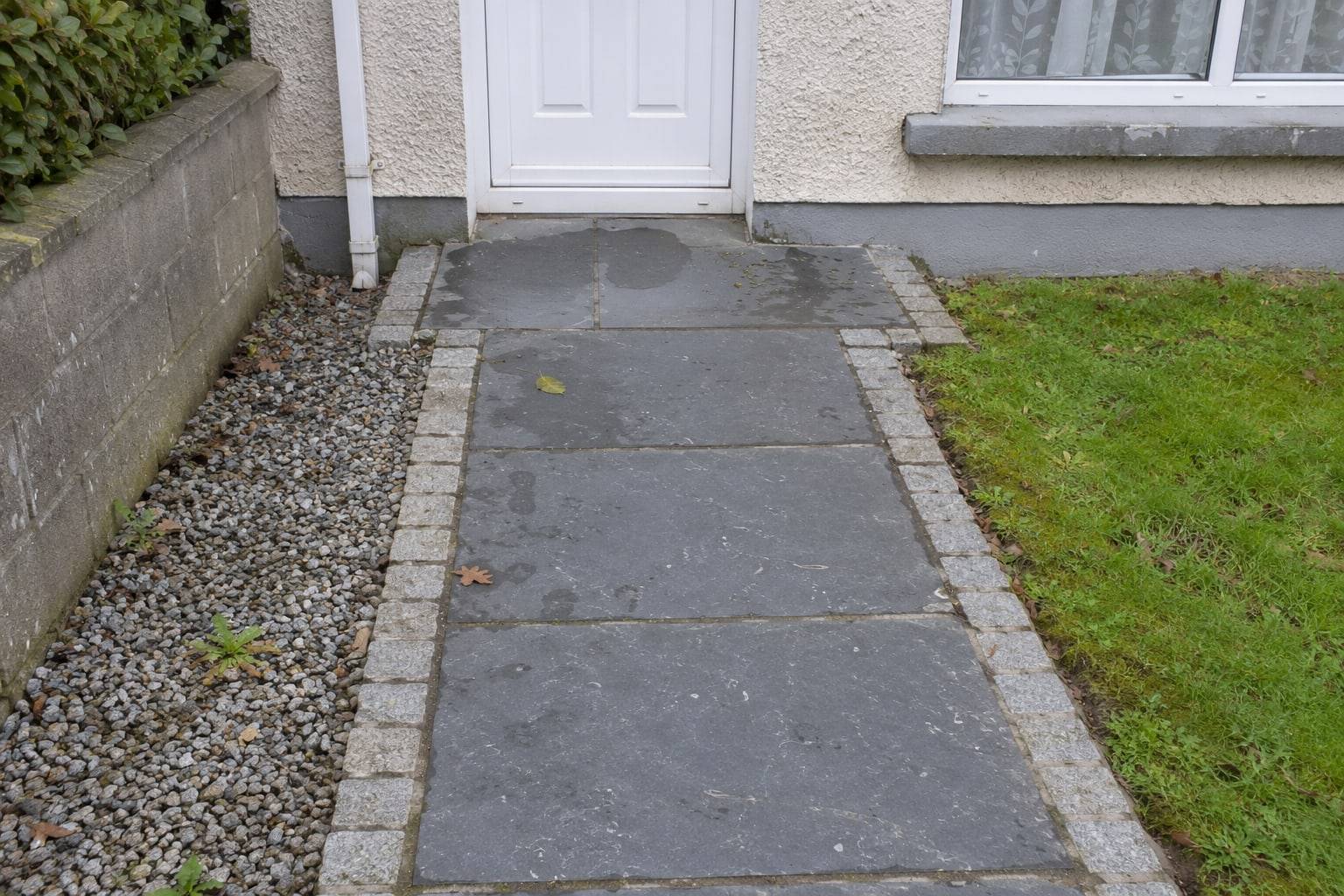
Kilkenny Limestone is a quarry group in Co. Kilkenny and Co. Carlow, and its information is published on the website of its Belgian parent, Brachot. It sells the stone in 18 finishes, including flamed, bush-hammered and stonewashed. The flamed finish is made by torching the stone with an open flame, which leaves a speckled grey, irregular surface.
The quarry says the flamed finish has excellent slip resistance, and that the smoother stonewashed finish becomes more slippery when wet. For the flamed finish it gives a test figure: "Tested wet PTV of 77 in line with EN 1341, providing low slip potential per UK SRG guidance." PTV is the pendulum test value. These are the supplier's own figures.
Thickness, water and frost
Kilkenny Limestone says "3 cm is generally sufficient for pedestrian patio areas". It says driveways need thicker slabs. To count slabs for a patio, use the paving slab calculator.
The quarry publishes these figures for its stone:
- "Water absorption: < 0.6%"
- "Frost resistance: > 168 freeze-thaw cycles, more than three times the 48-cycle requirement for class F1 under EN 12371"
It also says all its paving slabs comply with EN 1341, the European product standard for natural stone slabs for outdoor paving.
Sealing limestone
The quarry and an Irish retailer disagree. Asked whether its stone needs sealing, Kilkenny Limestone answers "No, sealing is not required." It says the stone is dense enough to resist staining and weathering on its own.
Royale Stones, an Irish retailer, writes about limestone in general. It says the surface is a bit more porous than a manufactured one and that "An occasional seal helps keep staining down". The quarry's answer is about its own stone.
Cleaning limestone
Kilkenny Limestone says it would not recommend a pressure washer. It suggests a garden hose and a soft brush, with a mild cleaner if needed.
Acid cleaners damage limestone. Paving Expert, a British technical site, says limestone is dissolved by hydrochloric acid. London Stone, a British retailer, says acid cleaners "should never be used, in any circumstances, on calcareous stones like limestone, marble, and travertine." See cleaning and sealing paving for other stains.
Granite
The granite advice here comes from retailers in Ireland and Britain. For granite setts on a driveway, Royale Stones warns that "Individual setts can move slightly if the base wasn't compacted properly". One British retailer says a sett driveway needs edge restraints put in first, and rigid mortared joints where cars go. The sub-base calculator works out the stone for a base once you know the depth.
The same British retailer says a flamed finish gives granite natural slip resistance, and that "Granite's very low porosity means it resists staining and moisture without sealing, unlike sandstone and limestone." On cleaning, London Stone says some situations may warrant acid cleaners on stones that are not calcareous, and names granite among them.
Sources
- Brachot Academy (Kilkenny Limestone): patios in blue Kilkenny limestone
- Brachot Academy (Kilkenny Limestone): limestone paving
- Royale Stones: driveway paving buying guide (Irish retailer)
- London Stone: beware of using acid to clean natural stone paving (British retailer)
- Paving Expert: taking care of paving (British)
- Universal Paving: granite paving setts guide (British retailer)
This page is general information taken from published guidance. Products differ, so follow the laying and care instructions for the one you buy.
Related guides
- Indian sandstoneColours and finishes, calibrated slabs, staining and algae, and how the stone is sourced.
- Porcelain pavingWhat outdoor porcelain is, how it has to be laid and where it goes wrong.
- Cleaning and sealing pavingAlgae, black spot, white bloom and rust marks, and when a sealer is worth using.
- How a patio is builtThe layers from the ground up: digging out, sub-base, falls, bedding and jointing.